SINTEPLAST
From 250,000 to 500,000 liters per day: How we doubled Sinteplast's shipping capacity.
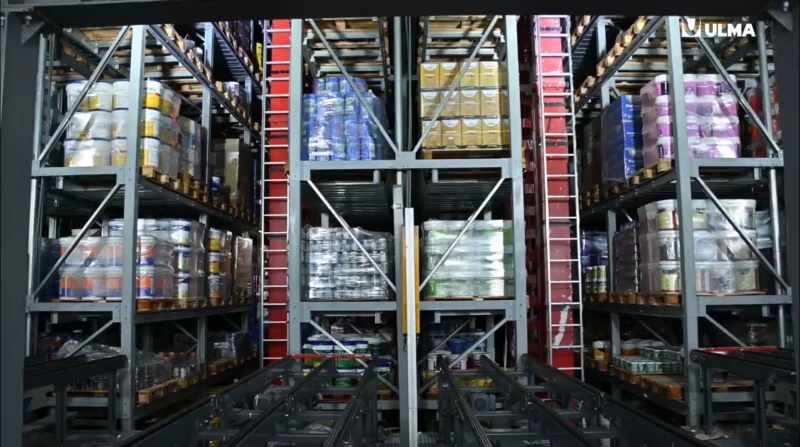
Sinteplast entrusted us with the task of fully automating its distribution center—from goods receipt to shipping—with an automated warehouse 40 meters high and 18,000 pallet positions.
A warehouse at 95% capacity, and a business that couldn’t wait.
Sinteplast found itself with warehouses at capacity: a 95% occupancy rate that was beginning to hinder both storage capacity and order fulfillment. With only 3,000 m² available for expansion, the company had two options—and only one of them made sense in the long term.
Sinteplast
Founded in 1958, Sinteplast is now the leader in the Argentine paint market, under the slogan "We make your dreams come true." Innovation, development, and commitment have been key to its growth and consolidation as a company.
The Challenge
"We had 3,000 m² of available space to expand our warehouse, but if we built it using conventional methods, we could accommodate 4,000 additional storage locations. On the other hand, if we opted for an automated warehouse solution, we would have space to store 18,000 pallets in a 40-meter-high warehouse,” explains Martín Müller, planning and logistics manager at Sinteplast.
The decision was clear: build upward, not outward. The challenge was to automate the entire workflow—from receiving to shipping—without wasting a single square meter along the way.
Warehouse at 95% capacity

Only 3,000 m² available for expansion

Restrictions on Storage and Picking

The Need to Scale Up Without Losing Space
The solution
from ULMA
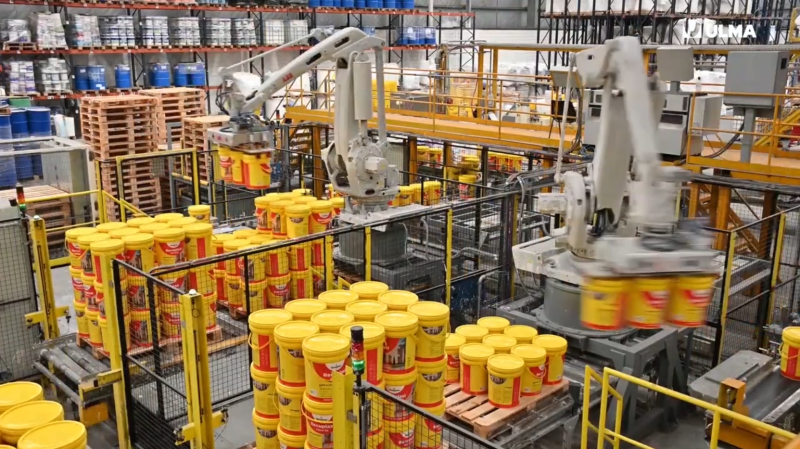
We designed an end-to-end automated intralogistics solution. Finished product inbound shipments are managed by a system of STV (Sorting Transfer Vehicle) carts, which feed a 10-aisle automated warehouse where 5 pallet stacker cranes operate. Thanks to the installed traverser, these stacker cranes can move between aisles, giving the facility total flexibility.
And best of all: the solution is fully scalable. If Sinteplast needs more capacity in the future, all it needs to do is add more stacker cranes to increase throughput within the warehouse.
“Thanks to the automated solution, we’ve seen a drastic reduction in inventory adjustments and picking errors,” notes Müller. “We used to follow the ‘person-to-product’ concept at our facility, but today, the product comes to the person.”
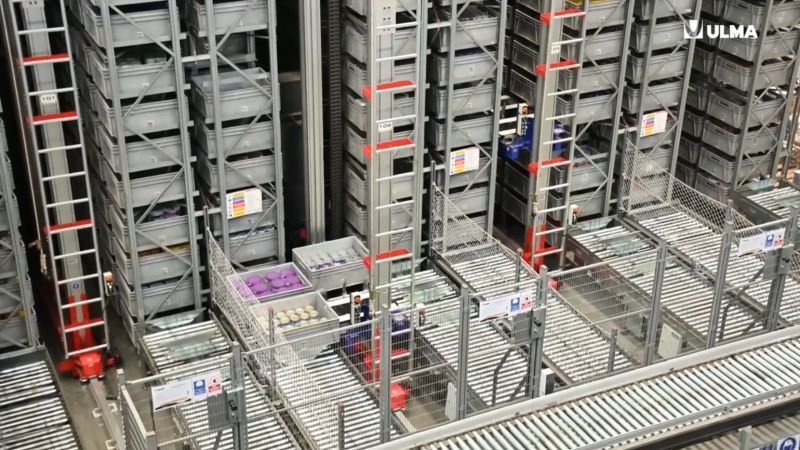
Order fulfillment features 5 picking stations based on the Product-to-Person model, capable of processing up to 25 orders simultaneously. “The system offers great flexibility because it operates on two subsystems: one for pallets and another for plastic bins, which allows us to handle both small and large orders,” Müller continues. Once order fulfillment is complete in the pallet zone, the orders are consolidated in the plastic basket zone—managed by an automated mini-load warehouse—where the pallet is filled with small items before being sent to shipping.
The result
The results speak for themselves: Sinteplast doubled its order-fulfillment capacity, increasing from 250,000 liters per day to 500,000 liters per day. Storage space was optimized to the fullest, productivity and efficiency in the intralogistics process saw a significant leap, and thanks to its scalable design, the facility is poised for even further growth in the future.

40-meter-high automated warehouse
Scalable Stacker Crane System

"Good to Person" Model
Testimonial
"If we had continued using the old technology of 3.20-meter aisles in conventional selective racking, with order pickers, we would have gained about 3,000 storage locations. With ULMA’s solution and an automated self-supporting storage system, we were able to fit approximately 18,000 pallet storage locations across 23 levels into that same space."
Martin Müller
Planning and Logistics Manager
"Our warehouse was 95% full, and our shipping and storage capacity was quite limited, which led us to consider a new investment."
"The system is completely flexible because it combines this pallet system with a basket system."
"With the ULMA warehouse, we were able to double our shipping capacity, from 250,000 to 500,000 liters per day."